How to Ace the ARE 5.0 PDD Exam: Deconstructing NCARB Sample Questions with AI
- ARE TUTOR
- Feb 20
- 4 min read
The Challenge of PDD (Project Development & Documentation)
Among the six divisions of the ARE 5.0, PDD is notorious for its depth. It’s the "how-to" exam of architecture, requiring a mastery of detailing, structural integration, and code compliance. Many candidates find the NCARB Demonstration Exam helpful, but the static answer key often leaves out the most important part: The "Why" behind the answer.
Step-by-Step: Solving a PDD Sample Question with AI
We put our PDD Mentor to the test using a complex scenario from the official NCARB sample set. Here is how the AI transformed a difficult question into a clear learning moment:

(Question source: NCARB official ARE 5.0 Demonstration Exam)
Here is how ARE TUTOR responded:


Real-World PDD Challenge: Choosing the Right Cost Savings
In the PDD exam, you aren't just looking for the biggest discount; you are looking for the change that protects the design intent. We asked our PDD Mentor to evaluate five cost-saving options for a building in a cold climate where energy performance is the top priority.
1. The Recommended Choices (Smart Savings)
The AI identified three options that save money without compromising the building envelope's thermal integrity:
Hardware (Save $5,000): Switching from custom to manufacturer’s standard hardware. Since hardware doesn't impact U-factor, it's an easy win.
Finishes (Save $20,000): Changing from a fluoropolymer coating to an anodized aluminum finish. This is a massive saving that has zero impact on energy loss.
Aesthetic Tinting (Save $2,000): Changing window tint color (brown to grey) is acceptable, as tinting alone has minimal impact on the U-factors critical for cold climates.
2. The "Red Flag" Options (What to Avoid)
This is where candidates often lose points. Our AI Mentor explains why these tempting savings are actually design failures:
Reducing Air Space (3/4" to 1/4"): This significantly worsens the window's U-factor, directly contradicting the goal of reducing heat loss.
Removing Low-E Coatings: This would dramatically increase heat loss. The AI cited Fundamentals of Building Construction to remind us that Low-E is a standard feature for high-performance windows.
3. The Evidence: No More "Guessing"
One of the most powerful features of ARE TUTOR is the citation list. For this problem, the AI didn't just give an opinion; it verified the logic across multiple NCARB-approved sources:
Mechanical and Electrical Equipment for Buildings (MEEB)
Heating, Cooling, Lighting: Sustainable Design Methods
Fundamentals of Building Construction
The "Why" Matters More Than the "What"
In our previous question, we saw how the PDD Mentor solved a complex cost-saving problem regarding window specifications. But for a candidate, the real value lies in understanding the underlying map: What is NCARB actually testing? and Where should I study to master this?
We asked our AI Mentor to deconstruct the exam objectives and common pitfalls for this specific challenge. Here is the breakdown:



1. Mapping the Exam Objectives (The NCARB Blueprint)
This question is a classic integration challenge. Based on the October 2025 ARE 5.0 Guidelines, it hits three critical objectives:
PDD Objective 5.1 (Construction Cost Estimates): This is the primary test. You are performing Value Engineering while acting as the steward of the design intent. You must protect non-negotiable priorities—like energy performance—against cost-cutting measures.
PPD Objective 5.1 (Design Alternatives): You are evaluating alternatives (vestibule removal vs. hardware changes) against the building program.
PPD Objective 4.1 (Quantitative Attributes): You must understand the quantitative impact of the U-factor (thermal transmittance) on the building’s overall efficiency.
2. Your Specialized Reading List: Where to Study
Stop flipping through 1,000-page textbooks aimlessly. To master these concepts, the AI recommends focusing on these specific chapters:
MEEB (Mechanical and Electrical Equipment for Buildings):
Chapter 3 (Thermal Control): This is non-negotiable. Master U-factor, R-value, and the role of the optimal air space (typically 1/2" to 1") in an IGU.
Chapter 7 (Lighting & Daylighting): Understand that tint primarily affects aesthetics and VLT, but does very little to improve the U-factor.
Building Construction Illustrated (Ching):
Chapter 7 (Thermal & Moisture Protection): Study curtain wall sections and the concept of thermal breaks.
Chapter 8 (Doors & Windows): Review why entry vestibules function as critical air locks to reduce infiltration.
Architectural Graphic Standards (AGS):
Section 10: Use this to distinguish between performance specifications and aesthetic/durability specifications (like finishes and hardware).
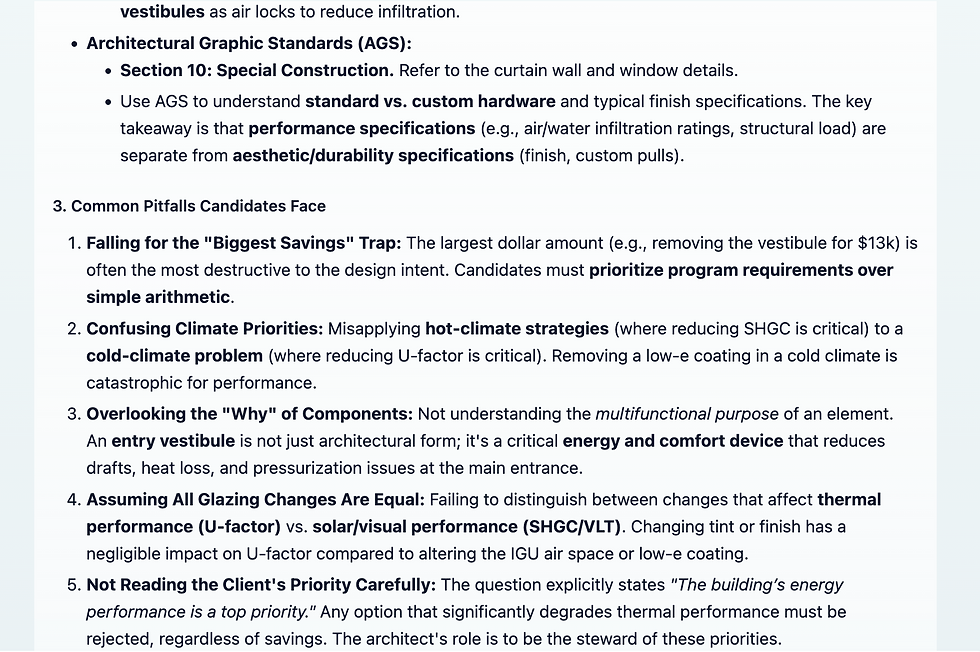
3. Avoiding the "Biggest Savings" Trap
Our AI Mentor identified the most common pitfalls that cause candidates to fail this type of question:
Prioritize Logic Over Arithmetic: Don't just pick the options with the highest dollar amount. Removing a vestibule might save $13k, but it destroys the energy strategy.
Know Your Climate: Don't apply hot-climate strategies (reducing SHGC) to cold-climate problems (where U-factor is king).
Component Multifunctionality: An entry vestibule isn't just an architectural feature; it's a critical comfort device that prevents drafts and heat loss.
Conclusion: Study Smarter, Not Harder
The architect’s duty is to defend the design intent. ARE TUTOR is designed to help you build that professional judgment. For the cost of one coffee a week ($29.9/mo), you get a mentor that connects every question to the official reference books and the latest NCARB objectives.
Comments